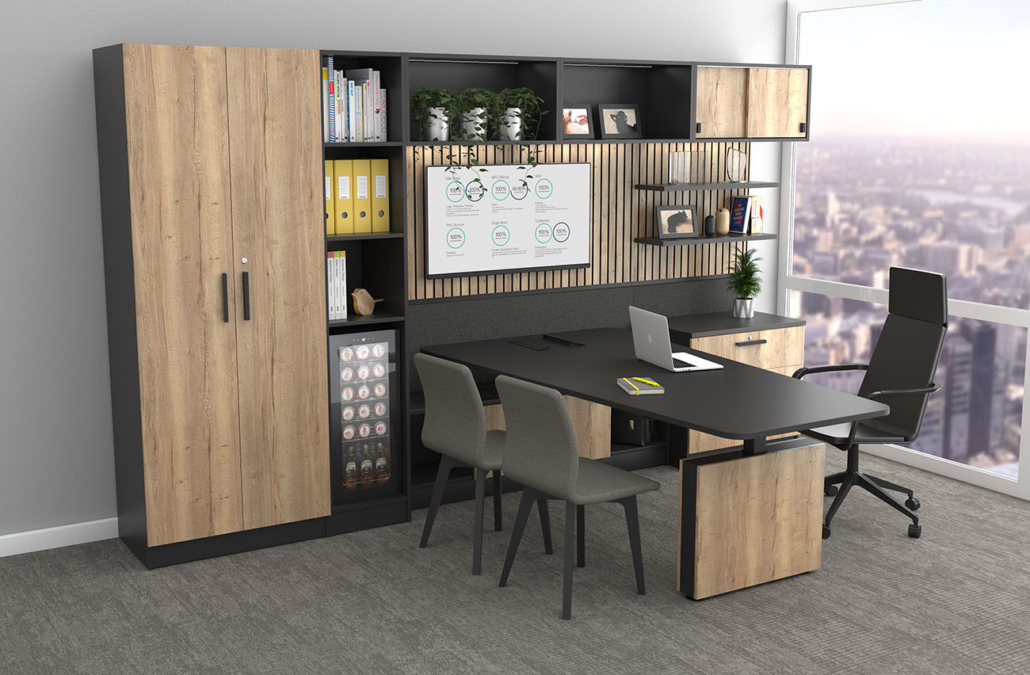
What makes high-quality office furniture?

What makes truly high quality office furniture? A manufacturer's perspective
In this article
- Why this question matters more than ever
- It starts with the materials
- Construction: what you can't see is what counts
- The finishing details that separate good from great
- Certifications worth looking for
- Warranty: the manufacturer's confidence test
- What budget furniture cuts — and when you'll notice
- Questions to ask any office furniture supplier
- How Staverton approaches quality
When you're investing in office furniture - whether it's desking for a hundred people, a boardroom table for your senior leadership team, or a locker system for a hot-desking floor - quality isn't just about how things look on day one. It's about how they perform on day one thousand.
We're Staverton, a British office furniture manufacturer that's been designing and making furniture since 1928. Our 38,000 sq ft factory is in Rotherham, and we have a showroom in Farringdon, central London, where customers can see and feel our products before they commit. Nearly a century of manufacturing has taught us a great deal about what good furniture looks like from the inside - and what cheaper alternatives look like when they start to fail. This article shares what we've learned.
Why this question matters more than ever
The modern office is doing more than it ever has. Hot-desking, hybrid working, agile layouts, collaborative zones - today's workplace furniture needs to flex, reconfigure, and withstand heavy daily use from people who don't treat it as their own. That puts quality under real pressure.
At the same time, procurement budgets are scrutinised more carefully than ever. The temptation to cut costs on furniture is understandable. But the total cost of ownership - factoring in replacement, downtime, and the message poor furniture sends to your team - tells a different story. High-quality office furniture, specified correctly, is almost always the more economical choice over a five-to-ten year time frame.
So what does high quality actually mean in practice? Let's break it down.
It starts with the materials
The majority of professional office furniture - desks, storage, modular wall systems, credenzas - is built primarily from melamine-faced chipboard (MFC). Done well, MFC is an excellent material: stable, consistent, available in a huge range of finishes, and highly durable. Done cheaply, it's a liability.
The differences that matter most are board density, surface quality, and how the material is processed. Higher-density boards resist sagging under load, don't swell when exposed to moisture, and hold fixings more reliably over time. Surface quality affects how the furniture wears - cheap melamine surfaces scratch, chip, and delaminate under normal office use far sooner than premium alternatives.
At Staverton, our MFC is sourced from certified suppliers in line with our FSC certification, which means the timber content is responsibly and sustainably managed. That matters for your sustainability reporting as much as it does for material quality.
For structural elements - frames, legs, and support structures - the quality of materials and the precision of fabrication makes a significant difference to long-term rigidity. Well-constructed frames distribute load evenly, resist racking, and maintain their integrity through years of daily use. It's not glamorous, but it's the difference between furniture that's still solid in year eight and furniture that's embarrassing by year three.
Construction: what you can't see is what counts
This is where the real difference between high-quality and budget office furniture lives - and it's deliberately hidden from view.
Joint construction is the most important factor in furniture longevity. A desk or cabinet that's going to last a decade needs joints that are properly reinforced and built to withstand repeated stress. Budget manufacturers routinely reduce the number of fixing points, use lower-grade hardware, or skip reinforcement entirely. The furniture looks identical on day one. By year three, you'll feel it in the wobble.
Frame and worktop support is similarly invisible but critical. A desk spanning 1,600mm or more needs adequate support beneath it to prevent deflection under load. Premium manufacturers build this in as standard. Budget alternatives cut it out to reduce material cost - and the worktop gradually bows under the weight of monitors, equipment, and everyday use.
At Staverton, our factory uses precision-engineered processing machinery that ensures every panel is cut and edged to consistent tolerances. That consistency matters more than it might sound: furniture that's slightly out of square will never sit right, and the stress it places on joints accelerates wear over time.
One question we wish more buyers asked us: "What support features are built into your products to increase longevity and lifespan?" It's the question that separates manufacturers who think long-term from those who are optimising for the lowest possible price.
The finishing details that separate good from great
Edge banding is one of the clearest visual indicators of furniture quality - and one of the first places budget manufacturers cut costs. On a high-quality piece, edge banding is applied with precision, sits flush with the panel face, and is thick enough to protect the board from impact and moisture ingress. On cheaper furniture, it's often thin, slightly proud of the surface, and prone to lifting at corners.
Run your hand under a worktop. Feel the edge. If it's sharp, thin, or already beginning to lift on a showroom sample, that's telling you something important about how the rest of the piece is made.
Cable management is another detail that distinguishes serious manufacturers from those focused purely on aesthetics. In a working office, every desk needs to manage power and data cables - and furniture that doesn't account for this from the design stage creates a mess that's both unsightly and a health and safety issue. Good cable management is designed in, not bolted on as an afterthought.
Surface finish consistency - particularly on high-touch areas like worktops and locker doors - is the final test. Premium laminates are more resistant to staining, scratching, and UV fade. They also tend to offer better colour consistency across a large order, which matters considerably when you're fitting out an entire floor and need everything to match.
Certifications worth looking for
Certifications aren't everything, but they're a useful shorthand for manufacturers who take quality seriously enough to have it independently verified. Here's what to look for when evaluating any UK office furniture supplier:
FIRA Gold - Safety, durability & performance standard
ISO 9001 - Quality management systems
ISO 14001 - Environmental management
FSC - Responsible timber sourcing
FISP - Furniture industry sustainability
Safe Contractor - Health & safety accreditation
Staverton holds all of the above. Our products are designed to achieve FIRA's Gold standard - the recognised benchmark for durability and safety in the UK furniture industry - and we're members of BSI, the British Standards Institution. When a manufacturer has invested in this level of independent accreditation, it means their quality claims have been tested and verified by someone other than themselves.
Be cautious of suppliers who can't evidence any third-party certification. It doesn't automatically mean poor quality, but it removes any independent verification of their claims - and in a category where so much of what determines quality is hidden from view, that matters.
Warranty: the manufacturer's confidence test
A warranty is a manufacturer's public statement of confidence in their own product. The length and scope of what's offered tells you a great deal about how they genuinely expect the furniture to perform once it's in your office.
Staverton provides comprehensive warranty packages across our product range. We think of a warranty not as a legal formality but as a straightforward expression of confidence in how our furniture is built - and our warranties reflect that.
When evaluating warranties from any supplier, look beyond the headline. Check what's actually covered: does it include structural failure, surface defects, and hardware failure? What's the claims process? A warranty that takes months to action and requires you to return furniture at your own cost is worth considerably less than one with a clear, straightforward resolution process.
What budget furniture cuts - and when you'll notice
We're not going to pretend budget office furniture doesn't exist, or that every business has an unlimited specification budget. But buyers deserve to know exactly what they're trading off. Here's what gets cut first, in our experience:
- Edge banding thickness and application quality - you'll notice within 12–18 months as edges start to lift, particularly on worktops and locker doors that take daily contact
- Joint reinforcement - fewer fixing points and lower-grade hardware leads to wobble and structural loosening, typically within two to four years in a busy hot-desking environment
- Frame and worktop support structures - inadequate support causes deflection under load and racking in storage units; it's invisible until it isn't
- Surface laminate quality - cheaper melamine scratches and stains faster and shows wear visibly, affecting the look of your office long before the furniture actually fails
- Cable management - often omitted entirely, or offered as a chargeable add-on after the fact
- Finish consistency - colour matching becomes noticeably inconsistent across large orders, and replenishment orders placed months later rarely match perfectly
None of these compromises are immediately obvious in a product photograph or a quick showroom visit. That's precisely why certifications, warranties, and direct conversations with the manufacturer matter as much as they do.
Questions to ask any office furniture supplier
Whether you're buying from Staverton or anyone else, these are the questions worth asking before you commit to a specification:
- What support features are built into your products to increase longevity and lifespan?
- What certifications do you hold, and can you share documentation?
- What testing standards are your products designed to meet?
- What does your warranty cover, and what's the claims process if something goes wrong?
- Can I see the furniture in person before ordering?
- How do you handle colour consistency across large orders and future replenishment?
- Where is the furniture manufactured, and can you tell me about your supply chain?
- What's your lead time, and how do you manage delivery and installation?
A supplier who gives clear, confident answers to all of the above is worth considerably more than one who deflects or generalises. Quality manufacturers are proud of how they work - and they'll tell you.
How Staverton approaches quality
We've been manufacturing office furniture since 1928. That's not a number we drop casually - it represents nearly a century of learning what works, what doesn't, and what it takes to build furniture that professional organisations trust to perform day after day.
Our 38,000 sq ft factory in Rotherham uses precision processing machinery that allows us to work at genuine scale without compromising on the tolerances that matter. We're not a bespoke joinery; we're a manufacturer that combines volume capability with a genuine, long-standing commitment to quality. We hold FIRA Gold, ISO 9001, ISO 14001, FSC, FISP, Safe Contractor, and BSI accreditation across our operations.
We supply directly to end users - professional services firms, corporate occupiers across London, Manchester, and other major cities - as well as to dealers, architects, and design-and-build contractors. Whatever route you come through, you get the same product and the same comprehensive warranty package behind it.
If you want to see the quality for yourself before you commit, our showroom in Farringdon, central London, carries a wide range of our products. We'd genuinely rather you came and ran your hand along the edge banding than trusted a photograph on a screen.
Specifying furniture for an office project?
Whether it's a full fit-out, a hot-desking floor with agile desking and employee lockers, or a new boardroom, we're happy to talk through what's right for your space. Get in touch with the Staverton team:
Call us: 020 3794 1200 · Email: info@staverton.co.uk